Bouldering and fear of heights: myths and reality
A fear of heights is often one of the first reasons people put off their first visit to the crag or a bouldering gym. Many assume that climbing is only for people who feel no unease at all at height, but the reality is quite different. In practice, lots of people who feel fear, insecurity or mild anxiety can still enjoy climbing, especially once they learn the right approach, safety procedures and movement technique.
Is every fear of heights the same as acrophobia?
Not every bit of unease at the edge of a cliff, a balcony or a bridge means a person has acrophobia. It's natural to feel cautious when you're judging a fall, the distance to the ground or an unfamiliar situation. That feeling has a protective function and helps you make sensible decisions.
Acrophobia, on the other hand, is a specific form of intense and often irrational fear that goes beyond ordinary caution. A phobia like this can cause a strong freeze even in situations that are objectively safe. Symptoms of acrophobia can include a racing pulse, trembling, tension in the legs, dizziness, sweating, shallow breathing and a feeling of losing control. Some people also feel a strong urge to back out of the activity as soon as they look down.
It's important to tell the difference between normal caution and a state in which the problem becomes so pronounced that it limits everyday life and experiences that could otherwise be enjoyable and beneficial.
The myth that bouldering means hanging around “way up high”
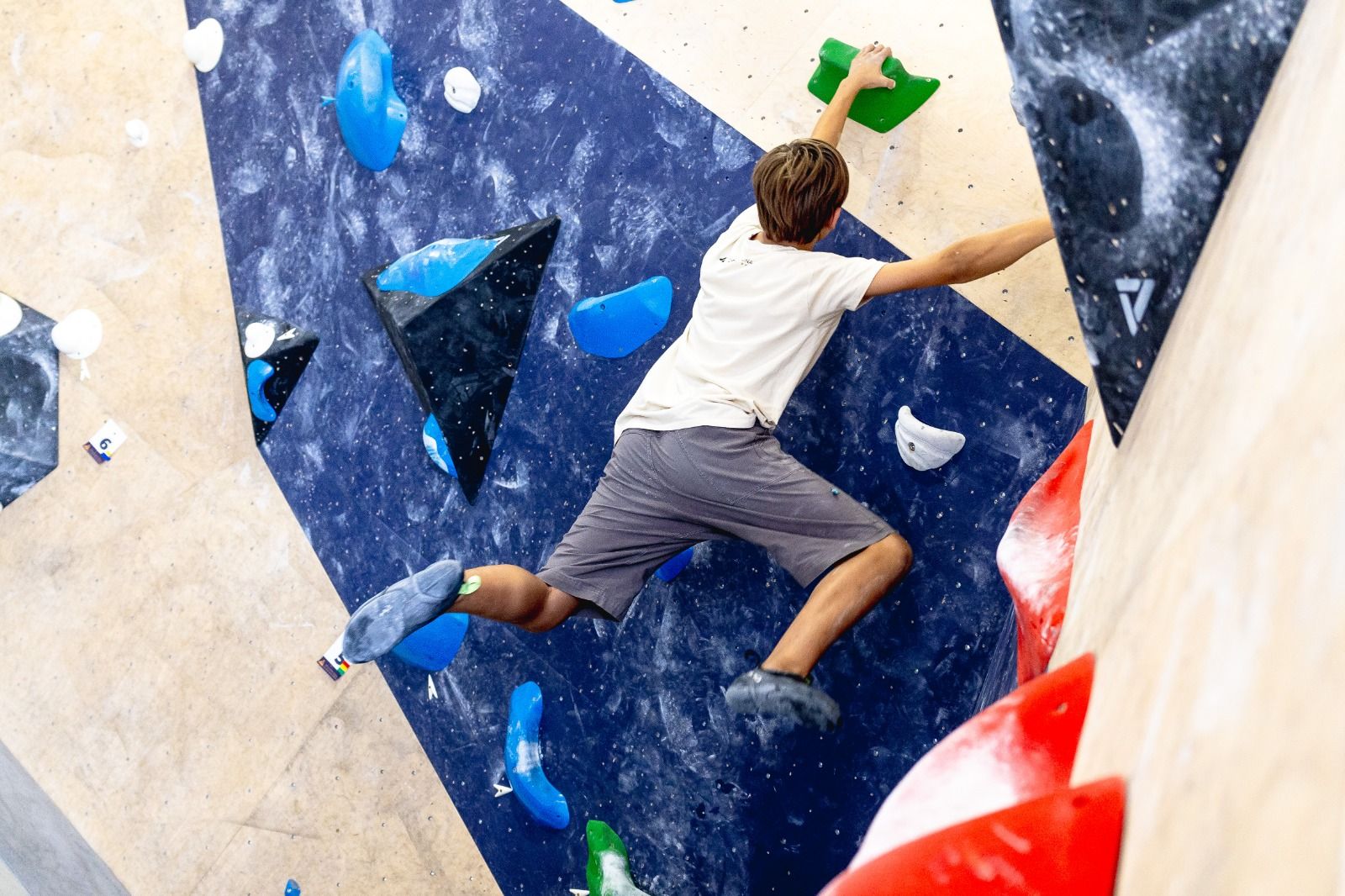
One of the most common myths is that bouldering means climbing at great heights. Quite the opposite: bouldering takes place on lower problems, without a rope, above thick mats that cushion your landing. That doesn't mean there's no responsibility or no need to learn to move safely, but it does mean that for many beginners the whole activity is psychologically more approachable than what they imagine when they hear the word climbing.
For someone with a fear of heights, bouldering can be a good first step because it lets you get used to height in a controlled way. Instead of facing a lot of exposure, you move on the lower sections of a problem, learn how to climb down properly and gradually build a sense of security. It also makes a big difference that the focus shifts from “how high is it” to “how am I moving”.
Technique reduces fear more than most people expect
When beginners first stand in front of the wall, they often think the main challenge is strength. In reality, technique plays a far bigger role. Placing your feet correctly, balance, breathing, shifting your weight and a calm pace of movement all directly affect how stable you feel.
The more precise your movement, the less it feels chaotic and out of control. And that very sense of control often reduces anxiety. Someone who knows how to climb down, how to distribute their weight and how to read a problem doesn't feel the same level of tension as someone relying purely on instinct. That's why intro sessions and expert-guided exposure are so important, especially for people for whom height is a psychologically sensitive topic.
Fear in the gym and fear outdoors aren't quite the same
Climbing indoors and climbing outdoors share the same basic principles of movement, but the emotional experience isn't always the same. In the gym, the situation is more predictable: the flooring is prepared, the environment is controlled, the problems are clearly set, and beginners can focus more easily on their own body and technique.
Outdoors, extra elements come into play: the texture of the rock, open space, wind, the view down and a stronger sense of exposure. For someone with a fear of heights, real rock can feel more intense even when the actual height isn't great. That's exactly why it's useful to first build basic confidence in indoor conditions and then gradually broaden your experience.
What's especially valuable about guided training and intro courses is that beginners don't just learn how to climb indoors – they develop movement patterns and mental confidence that later help them when they meet real rock outdoors. That transition isn't abrupt, but gradual and meaningful.
What a healthy approach to facing fear looks like
The worst approach isn't caution, it's force. If you feel uneasy, being told to “just don't look down” doesn't help. It's more useful to take it step by step, with realistic expectations.
It's good to start with a few simple principles:
- short exposure instead of forcing long attempts
- climbing easier problems with a focus on controlled movement
- learning to climb down safely, not just to climb up
- focusing on breathing and rhythm instead of imagined risk
- accepting that unease is a normal part of the early experience
An approach like this helps a person stop linking climbing purely with discomfort and start linking it with gradual progress. Over time, physical symptoms such as tense shoulders, stiff arms or rapid breathing often ease off too.
When fear is a signal that you need extra help
If a phobia is so pronounced that it shows up in everyday situations too, for example on stairs, on a terrace or when crossing a high bridge, then climbing isn't the first solution, but just one possible step later on. In cases like this, professional therapy can be an important help. Gradual exposure, breathing work and understanding your own reactions often do more good than trying to “jump over” the problem through sheer willpower.
Climbing can then play a supporting role, but only if it's adapted to the person's condition and guided without pressure. What matters is that the experience doesn't deepen a sense of failure, but builds trust in your own body and perception.
Why many people stay in climbing after that first fear
Interestingly, people often stay in climbing not despite their fear, but precisely because of what they learn through it. Climbing develops concentration, being present in the moment and the ability to break a complex situation down into small, manageable steps. That process doesn't only matter on the wall. It carries over into everyday life too, into making decisions, dealing with stress and building self-confidence.
So bouldering isn't a test of courage reserved for a select few, but an activity in which even a cautious person can find their own rhythm. When the environment, guidance and approach are set up well, a fear of heights stops being an insurmountable obstacle and becomes something you can understand, ease and bring under control through guided climbing, experience and good movement.
Art Rock League, round 3
Team building in Zagreb: bring your team together through bouldering challenges
What do I need to know before my first visit to Boulder Zona?